Comparing 2 EPIC Touring Bikes
This article is a summary of a recently published YouTube video comparing 2 of my touring bikes, which you can find here. Please know that every individual has a unique set of desires, needs, and constraints which contribute to whatever bike rig they may have. Use this page & video as some contemplative guidance as you figure out what you want for your future bike!
Follow my Patreon as I get ready to Bike across Eastern Canada this summer!!
So I have two epic touring bikes- the custom built Velo Orange Polyvalent frame I took around my tour in New Zealand and bikepacking adventures in Australia & Maryland, and then the Priority 600, an “all road, all terrain, all conditions” bike made to be a “performance daily commuter, road rambler, and gravel grinder in one precision package.
There are SO many differences between these two bikes, it would take me too damn long to type it all up for you here! The video above does the best job of visually assessing those differences with articulation and use-case scenarios about why you would or would not want something. I’ll just share a few of the bigger differences here and let you choose to investigate the video, product links and setups on your own for those more nuanced decisions you may make.
…. One last thing before I go to the most visible differences of these bikes. My Velo Orange bike is designed for gravel, MTB and bikepacking primarily, but can (ofc) do road as well. But the Priority 600 is designed for road and gravel, less so intense MTB. Both these bikes can “do it all”, but “doing it all” usually means you lean one way or the other on the 4-point scale of “crazy intense MTB trails with rocks and roots” to “road/paved cycling” vs “I’m in the middle of nowhere and need to be able to work on my bike easily” to “if something goes wrong there will be a bus to a bike shop not too far away” 👇
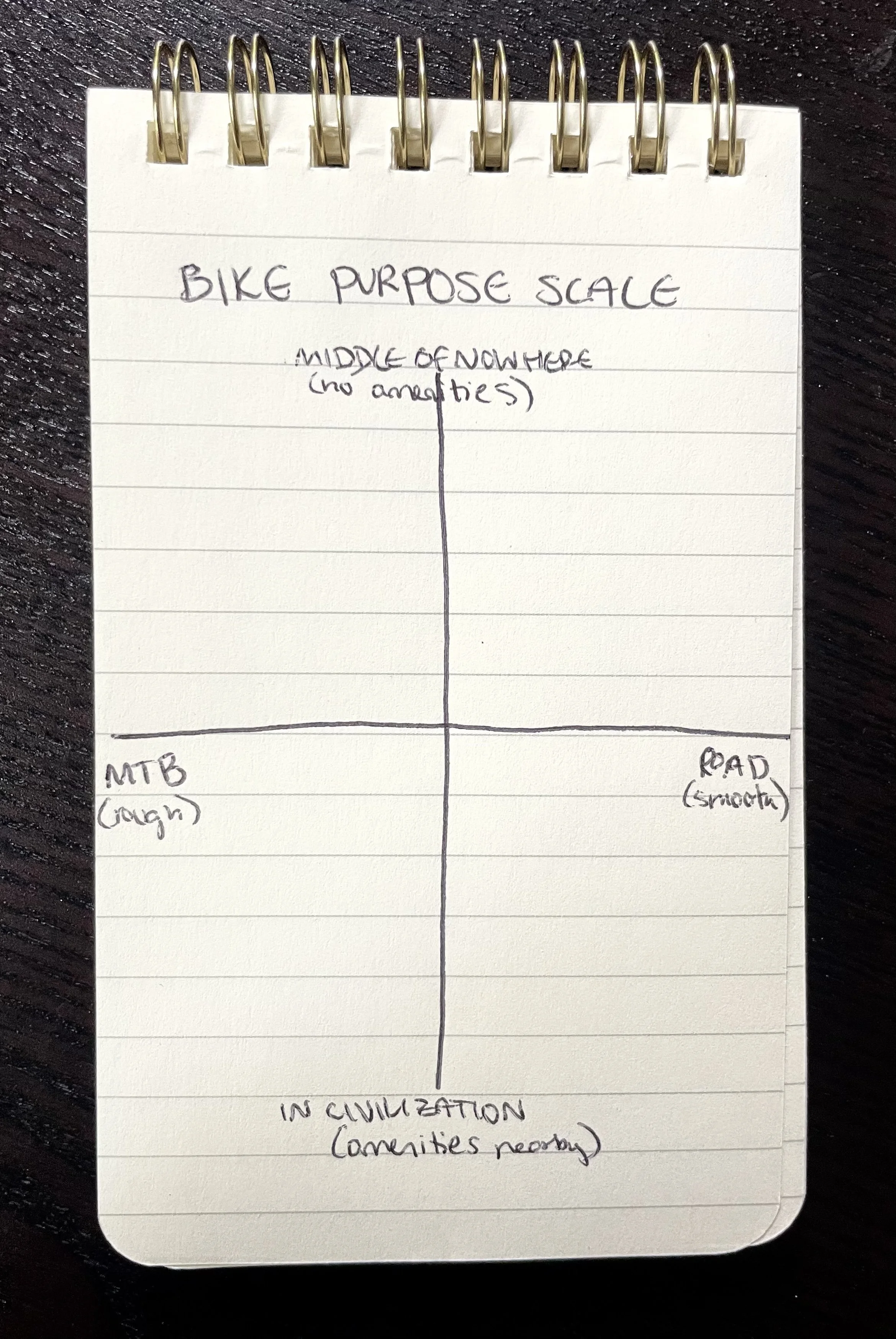
My mental scale of where bikes reside
Now, let’s get into it!!
Some of the biggest differences between these two bikes
Growtac (mechanial) VS Tektro (hydraulic) brakes
On my Velo Orange. Growtac brakes are supposed to be some of the BEST cable-actuated brakes out there for stopping power (very similar feel to hydraulic). I actually found these brakes to be quite finicky? They tended to work at 110% or at 50% power. Traditional cable brakes require more adjustments over time, which isn’t necessarily a problem (but you should only have to adjust them every several hundred to thousand miles at a time). Overall, I know people who love the Growtacs, but I found them to need adjustment on every other ride I went on (very agitating) and at times unsafe, becasue they’d lose their stopping power in the middle of a ride and you’d be pedaling and unable to slow down (OR it would stop too fast and you’d fly over the handlebars). Plus, many mechanics didn’t understand the Growtacs. Just my experience!
On my Priority 600. Tektro hydraulic brakes are reliable and strong without catapulting you overboard with excessive stopping power. I have these on two other bikes in addition to this one and they have yet to disappoint me. Hydraulic brakes work perfectly well right up until the point where they don’t. It’s hard to work on those brakes when you are in the middle of nowhere (they require flushing out the whole system which is near impossible unless you have the right tools/space around), so I think they would be best used in parts of the world with more bike shops around, rather than someplace super remote. Because my bike is fairly new, I don’t imagine I’ll have serious problems with these brakes (although I do tend to attract problems).
Crazy handlebars VS flat bars (with add-on horns)
I will probably never use drop bars again on a long tour (they just aren’t comfortable and are too narrow for steering with all that weight on board. Also I don’t like being that far bent forward).
On my Velo Orange. The Velo Orange Crazy Bars allow for an upright sitting position and two placements for your hands while riding (which can be essential for a long tour, it’s easy to get wrist/back pain if you’re cycling 250 miles a week for weeks on end). Only problem with these bars is that getting on/off trains can be a huge PIA (since your bars are gigantic) and putting your bike in a box for a flight can prove tricky at times. They’re great bars, but they are not modifiable, unless you stripped the bar naked and moved each part onto some new bars (a lot of work).
On my Priority 600. The Priority 600 has regular flat bars, but I got some extensions (if that’s what they’re called) to add more positions to reduce hand/back/wrist pain. This would essentially make these flat bars into a version similar to the Crazy Bars with the option to take them off as you please. I am excited for this because I am taking the Amtrak north and it’ll be easier to keep these bar extensions off the bike until I actually start my tour. I will probably try them on just to make sure they fit well instead of assuming they’ll be perfect. And when I’m done with the tour, I’ll take them off so I can pack it up in a bike box for a flight, and keep them off until my next adventure!
Traditional chan & cassettes VS Pinion gearbox belt-drive system
On my Velo Orange. My Velo Orange bike has a traditional (mountain biking) drive chain set-up with 2 gears in the front and 9 (?) in the back. That means two derailleurs (which means more parts to brake) and cleaning/lubing the chain and all over repeated use and bad weather. It’s simple (although if I had chosen a 1x system it would be even simpler) and like pretty much every other bike out there. BUT this also means that the chain can rust, it can get worn down, you can wear down your cassette and bend and break your derailleur. Lots of things to break and have to maintain on the road!
On my Priority 600. The Pinion gearbox system is supposed to be one of the best belt-drive systems on the market. I have never used these for long, but it effectively means that your shifting will work perfectly (if it’s setup right) forever until it brakes? No lubing and cleaning after mud and rain. No worrying about ruining an expensive cassette. I’m excited to try it out! But I need to get a spare belt just in case a freak accident happens (because many shops don’t have one on hand). I think the belt drive system will win in performance over a traditional drivechain.
Dynamo lights VS regular clip on lights
On my Priority 600. I LOVE dynamo lights so far! I don’t even know how they work but I also don’t care. They auto power on while you pedal and power off when you don’t. I find this to be an element of brain-free safety to add to your cycling. I have on an additional handlebar light for darker conditions because the Dynamo front light isn’t super bright whereas the additional clip on front light is much brighter in the dark (and doubles as a flashlight while I am at camp).
On my Velo Orange. Traditional clip on lights are simple and easy, but remembering to charge them is a PIA and can take up more of your (potentially) limited battery use. They also can get in the way of bags on your bike! Dynamo lights are probably going to be the winner for me.
Those are the main differences folks! You can watch my YouTube video above to get more detailed insights as to what makes each bike so awesome and flawed.